Story originally published at Scotland 5G Centre.
5G-Enabled testing at James Hutton innovation hubs for more efficient crop monitoring and management
Tay5G, a Tay Cities Region Deal project in collaboration with The Scotland 5G Centre and industry partners, aimed to accelerate the development of innovative projects utilising the power of 5G technology to transform various sectors including agritech.
We spoke to Andrew Christie, Agri-tech Specialist at The James Hutton Institute about the current challenges in the agriculture sector and what they’re looking to achieve as a Tay5G challenge winner.
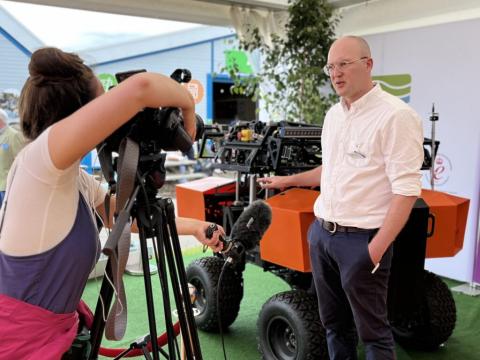
Andrew Christie, James Hutton Institute
1. Tell us about The James Hutton Institute?
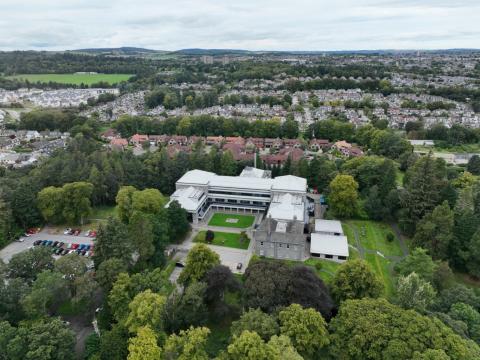
The James Hutton Institute is a globally recognised research organisation delivering fundamental and applied science with a multidisciplinary approach to study of land, crop and natural resources. Named after the father of modern geology, James Hutton, a leading figure of the Scottish Enlightenment, I like to think that we follow in the same path in the belief that rational, objective thinking and collaboration in different areas of expertise can help us overcome the big challenges of our day.
2. What are the current challenges that the agriculture industry is facing?
The current situation for farming is one of squeezed profit margins, limited labour availability, exposure to fluctuations in input and commodity prices and increasingly conflicting demands for land use to provide both safe, nutritious food supply and multiple environmental benefits. Farming commentators now regularly state that agriculture is in an existential crisis. Facing these issues, I see the importance of finding solutions, with the aid of technology, to help the farmer become more efficient, reduce costs, make their business more competitive and/or provide them greater independence.
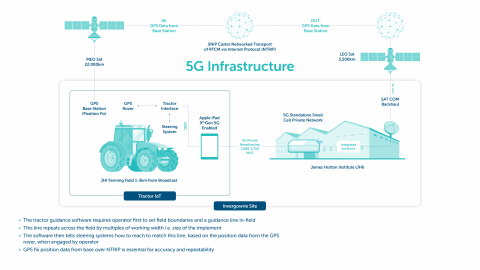
3. Tell us about the 5G Infrastructure at Farm?
On the institute research farm, we have rolled out a 5G private network antenna with a medium power broadcasting licence, to provide data connectivity to the majority of our land area on site. Internet backhaul via Starlink ensures that the antenna can be used as a standalone unit. Ruggedised 5G routers and antennas allow the practical deployment of high speed, low latency data connection to both our research and commercial farming operations.
4. As a Tay5G winner, what are you looking to achieve with this project?
The project revolves around two themes at Hutton. The first, looking at automating irrigation for efficient water use, which brings together an interconnected network of sensors which monitor conditions in the crop and responds real-time to control irrigation water supply. This is based on polytunnel fruit production for the use case demonstration, but is also relevant to vegetable and potato crops. The second theme is on retrofitting autosteer and telemetry to older equipment to provide sub-centimetre steering accuracy and real time data from the tractor over a 5G data connection. New equipment can be prohibitively expensive but parts and open-source software are available to provide similar levels of performance, if the farmer has the knowledge and skills. My aim is to provide a use case demonstration on both themes which proves that it can be done and is future proofed for 5G networks.
5. What does 5G offer the project?
The first aspect we wished to prove was that the systems we are using can operate on 5G network, therefore ensuring that future developments do not render current technology obsolete. In proving this, the potential for higher data transfer speed and low latency will allow us to expand our capabilities for in-field data collection exponentially. The future possibilities which this project may kickstart for both our ongoing research and innovations on farm include sensor networks for big data and robotic AI systems. We are just scratching the surface of what we can achieve with 5G in agriculture so far – the possibilities are limited only by our imagination.
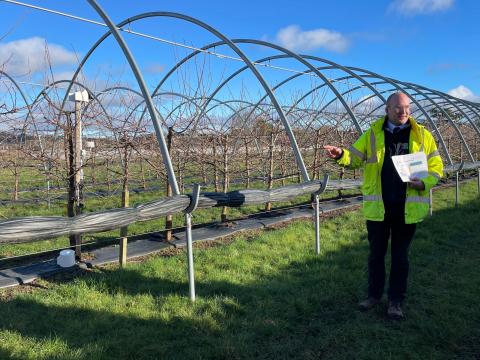
Crop Management with 5G and sensors
Process of Testing
The testing process was methodical and designed to offer a comprehensive understanding of the network's performance. It began with a thorough Signal Analysis, which was systematically conducted over the institute's area in a regular pattern. This ensured that every sector, from central hubs to peripheries, was accounted for. This phase was crucial in identifying any potential 'blind spots' or areas with weak coverage. Following the signal tests, we transitioned to the Speed and Ping tests, which were strategically executed at the deployment locations for the Teltonika RUTX50s. These tests were pivotal in understanding realworld performance metrics. The speed tests provided insight into data transfer rates, ensuring that research data, often hefty in size, could be swiftly and efficiently moved across the network. Concurrently, the Ping tests, which evaluated latency and jitter, gave us a clear picture of the network's responsiveness, a crucial factor for real-time research applications. Each phase of testing was carefully documented, with data being logged for subsequent analysis. This rigorous approach ensured that our findings were not only accurate but also actionable.
Key Findings
Upon concluding the thorough testing of the Private 5G network at the James Hutton Institute, several vital insights emerged: -Broad Coverage: For the majority of the institute's premises, the 5G signal coverage was found to be robust. The distribution was consistent, suggesting that the installation process was largely successful in meeting the coverage objectives set at the onset. -South-East Challenges: A noticeable exception to the broad coverage was the South-East potential location. Tests in this area revealed a significant drop in signal strength, would likely impact service quality. It is crucial to address this area, especially if it's slated for intensive research activities that require stable connectivity.
-Real-world Performance Metrics: The Speed and Ping tests at the deployment sites for the Teltonika RUTX50s revealed impressive data transfer rates and network responsiveness. This suggests that the network can handle sizable research data and facilitate real-time applications without hindrance.
-Network Responsiveness: The Ping tests, particularly those measuring latency and jitter, returned favorable results in most locations. Such low latency implies that the network is not only fast but also reliable, with minimal delays that could otherwise disrupt real-time data exchange or remote research operations.
-Ready for Advanced Implementation: With the current setup and performance of the network, it is evident that the institute is primed for the next phase. This includes the integration of research equipment via Teltonika routers and the planned implementation of Quality of Service (QoS) measures to further optimize the network's efficiency.
In summary, the Private 5G network at the James Hutton Institute is performing commendably in most areas, with specific challenges identified that can be addressed in subsequent optimization phases. The groundwork laid by this network establishes a strong foundation for the institute's future research endeavors.